

Understanding the Subtle Difference Between “Tired of Life” and “Tired from Trying.”
By: Christina Crowe, RP
Some people come to therapy saying, “I think I’m depressed.” And sometimes they even specify they don’t feel sad, but also don’t feel much like doing anything. It’s hard to put their finger on it.
They’ve lost interest in hobbies. The dishes pile up, emails go unanswered, and as they wonder, “Why can’t I get my life together“, and that might start to feel a bit depressing.
They describe feeling “tired all the time,” “flat,” or “unmotivated.” They don’t remember the last time they felt energized. And others remember exactly when they felt better, and after thinking about it for a bit, can also start to remember what else was different in their life around that time.
As your therapist, we want make sure that we’re treating the right thing, and that together, we’ve properly identified what it is that’s been holding you back, or worsening your experience of life.
Both depression and Attention Deficit Hyperactivity Disorder (ADHD) run the risk of making the other worse the longer they go unrecognized.
When we dig deeper with you, if you are coming with symptoms of depression that point to reasonable or sensical causes (rather than shifts that came without much warning), and we also know you have a diagnosis if ADHD, we do the work of discerning the nuances that come along with having an ADHD brain. (Of course, this is immeasurably easier if you already know you have ADHD).
Often trying to figure this how to tease apart these experiences is what leads us to the most tailored treatment approach, the stuff of how we start the work of feeling better again.
Dysthymia: When the Low Mood Never Leaves

Mild depression is one of the most common comorbidities of ADHD, and even more so if you were diagnosed later in life as an adult. It is well described among the expert community that undiagnosed and therefore untreated ADHD lead to anxiety, and untreated anxiety leads to depression in the natural course of ADHD across the lifespan.
Dysthymia (also known as Persistent Depressive Disorder) isn’t the kind of depression that knocks you down suddenly. It’s more like a dimmer switch on life that’s been turned down for years.
People with dysthymia say things like:
- “I can’t remember the last time I felt joy.”
- “I’m not exactly sad… just never really up.”
It’s not situational or reactive. By definition, it lasts at least two years (in adults), without real relief for more than two months at a time.
This is the crucial diagnostic line: if the low mood has been continuously present for two or more years, dysthymia rises to the top of our diagnostic suspect list.
ADHD: When the Fire Keeps Going Out

While this can affect any subtype of ADHD, sometimes this particular issue creeps up more with inattentive ADHD. Inattentive ADHD and forms of depression can looks very different on paper, but can feel eerily similar in daily life.
We often hear people with ADHD saying some variation:
- “I want to do things, I just can’t seem to start.”
- “Some days I’m unstoppable. Other days I can’t get off the couch.”
In other words, the difference between what we want to do, and what we execute on is what is causing the problem. It’s not that we don’t know what to do. It’s that more than feelings seem to be sinking us in quicksand.
That discrepancy is the key. ADHD isn’t about not caring, but about the brain struggling to generate consistent activation to do what it needs to do. ‘Rise and grind’ culture has got nothing on neurobiological #brainfunctionproblems.
You might have brilliant bursts of motivation when something’s interesting, followed by weeks of low drive for “boring” but necessary tasks. When you are doing something you are organically interested in, you have no problem focusing.
That’s not laziness or apathy, but a neurobiological (and very well recognized) pattern of interest-based motivation.
Where They Overlap
The trouble with many things-ADHD, is that on the outside, or to an untrained eye, they can really look the same.
This is part of what contributes to the well researched problems of both late and misdiagnosis in adults (especially girls and women).
Both ADHD and dysthymia can show up as:
- Low motivation
- Difficulty concentrating
- Fatigue or overwhelm
- Emotional sensitivity
Does that list look pretty vague? That’s why so many adults (especially women) are misdiagnosed with depression for years before someone recognizes the ADHD underneath.
How to Tell Them Apart
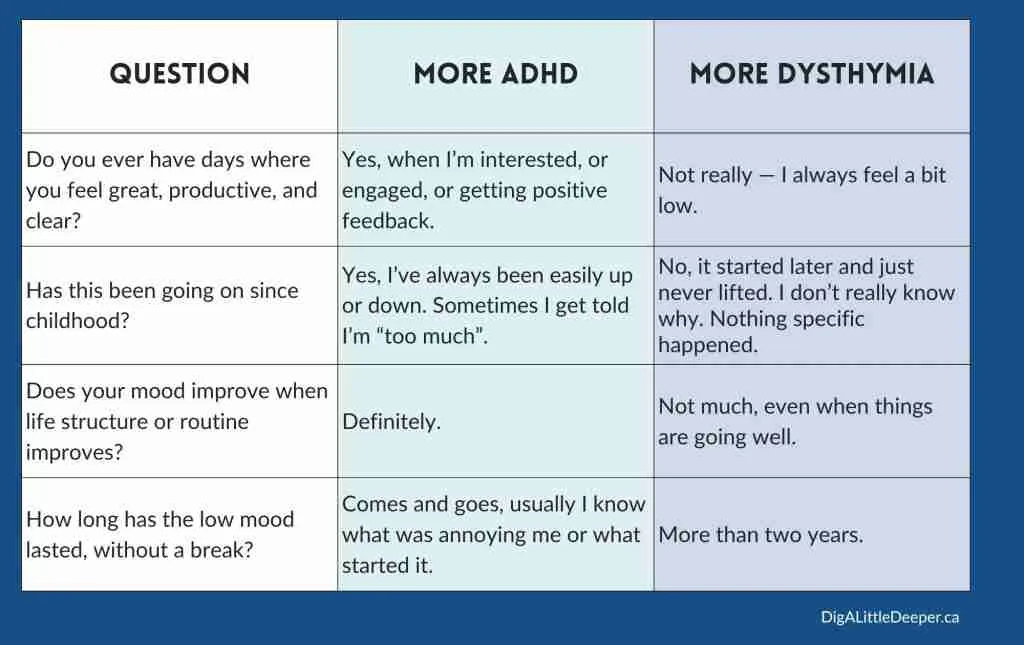
Over the last decade, I’ve learned lots of different ways to help tease apart what it is we are dealing with, or whether it’s actually both conditions. Some of the simplest ways to differentiate them come from small differences in how folks answer the same questions.
It starts to become apparent that time and pervasiveness are key factors to pay attention too.
Sometimes It’s Both
And sometimes… it really is both.
It’s important for you to know that each condition affects the recovery of the other. Recent research has found that people with ADHD who also have mild depression, that can actually impair your adherence to your ADHD medication. And if you have untreated ADHD, depression is a well known part of the natural progression if its left untreated into adulthood.
Living for decades with untreated ADHD, the missed deadlines, shame, and exhaustion of masking, can eventually create a chronic low mood that looks and feels like dysthymia.
We call this secondary dysthymia: mood changes that develop from long-term stress and demoralization.
In these cases, treating ADHD often lifts the emotional fog in ways antidepressants alone never could.

The Takeaway
We can’t always think our way out of the blah’s, or the lack of motivation, especially if the problem isn’t just emotional, but neurological.
Understanding whether your “meh” is ADHD-related or dysthymic helps you get the right kind of support. If you’ve never truly felt relief from therapy or medication, it may be time to revisit the diagnosis.
The treatment that works for one can fall flat for the other, or worse perhaps, overshadow the other one so much, that one of these never actually get treated properly, or to the fullest extent.
If You’re Wondering Where to Start
At Dig A Little Deeper, we’re trained and experienced in assessing both sides of this equation.
Whether you’re dealing with chronic low mood, burnout, or wondering if ADHD could explain more than you think, we can help you map the path forward.
You deserve more than surviving. You do deserve to feel alive again – and to not just wait around for the next woosh of inspiration or novelty.
TL;DR

If your “meh” has lasted more than two years, you might be living with dysthymia (persistent depressive disorder). If it’s more about inconsistent motivation, mental noise, or burnout from pushing against your own brain wiring — it might be ADHD. Sometimes, it’s both. But they need different treatment plans and equal attention, for the most straightforward path toward feeling better again.
References
ADHD treatment in Ontario | The ADHD Resource Hub. (2025, May 28). Dig a Little Deeper, Psychotherapy & Counselling. https://digalittledeeper.ca/add-treatment-in-ontario/
Nguyen, L., Le, Y. L., Reygaerts, H., Johnson, T. R., & Soutullo, C. A. (2025). Factors associated with medication adherence among patients with Attention-Deficit/Hyperactivity Disorder (ADHD). Journal of Attention Disorders. https://doi.org/10.1177/10870547251336852
Young, S., Adamo, N., Ásgeirsdóttir, B. B., Branney, P., Beckett, M., Colley, W., Cubbin, S., Deeley, Q., Farrag, E., Gudjonsson, G., Hill, P., Hollingdale, J., Kilic, O., Lloyd, T., Mason, P., Paliokosta, E., Perecherla, S., Sedgwick, J., Skirrow, C., Tierney, K., … Woodhouse, E. (2020). Females with ADHD: An expert consensus statement taking a lifespan approach providing guidance for the identification and treatment of attention-deficit/ hyperactivity disorder in girls and women. BMC psychiatry, 20(1), 404. https://doi.org/10.1186/s12888-020-02707-9
