Many symptoms associated with ADHD also appear in other mental health conditions. Difficulties with attention, motivation, sleep, mood or emotional regulation can also occur in anxiety, depression, trauma related conditions, learning differences, sleep disorders or substance use concerns.
Because of this overlap, responsible clinicians typically assess the full mental health picture rather than focusing on a single diagnosis. A comprehensive psychiatric or mental health assessment allows the clinician to understand the broader context of someone’s symptoms and functioning. This helps ensure that recommendations are based on careful clinical reasoning rather than a narrow screening process.
In recent years, many online services have emerged that focus specifically on ADHD. These services often advertise rapid assessments that can be completed in a short period of time.
While this approach may seem convenient, it may not capture the complexity of someone’s mental health history or current concerns. A thorough assessment usually includes discussion of medical history, mental health history, developmental background, functioning across school or work settings and screening for other conditions that may affect attention and executive functioning.
A careful assessment takes time because it is designed to understand the full clinical picture.
A reputable service is typically transparent about the clinicians involved and the process used for assessment and treatment. When reviewing a clinic, it is helpful to look for:
- Clearly identified licensed or regulated clinicians,
- Clinicians with experience assessing complex mental health concerns,
- A structured assessment process rather than a single screening questionnaire,
- Clear explanation of what information will be gathered and how recommendations are developed.
Responsible services will also be cautious about making promises about specific outcomes.
While every assessment is different, a thorough evaluation often includes:
- A detailed discussion of current concerns and symptoms
- Mental health and medical history
- Developmental history including childhood functioning
- Screening for overlapping or related conditions
- Exploration of functioning at school, work and in relationships
- Review of relevant records when available
The goal is to understand the person as a whole rather than focusing on a single symptom cluster.
No! We opened the service to the general public in the spring of 2023, after piloting the program internally since the fall of 2022. We carefully created processes and systems that will allow for the ethical and practical care of patients, and facilitating faster access to the care we know Ontarians want and need.
Anyone in Ontario can sign up through our new Screening Quiz, found on the main Integrated Mental Health Clinic service page.
It can be. Diagnosing ADHD is complex. No two people with ADHD are alike. ADHD affects functional, structural and neurochemical pathways in the brain, and presentations will vary based on individual peoples life circumstances, experience of other co-existing conditions and the level of external support they may or may not organically have. To complicate matters further, symptoms that look like ADHD might not signal an attention disorder. Figuring out what’s going on takes time, detailed investigation, and expert knowledge.
Bottom line: Diagnosing ADHD can’t be done with a simple checklist. It can’t be done in 15 minutes.
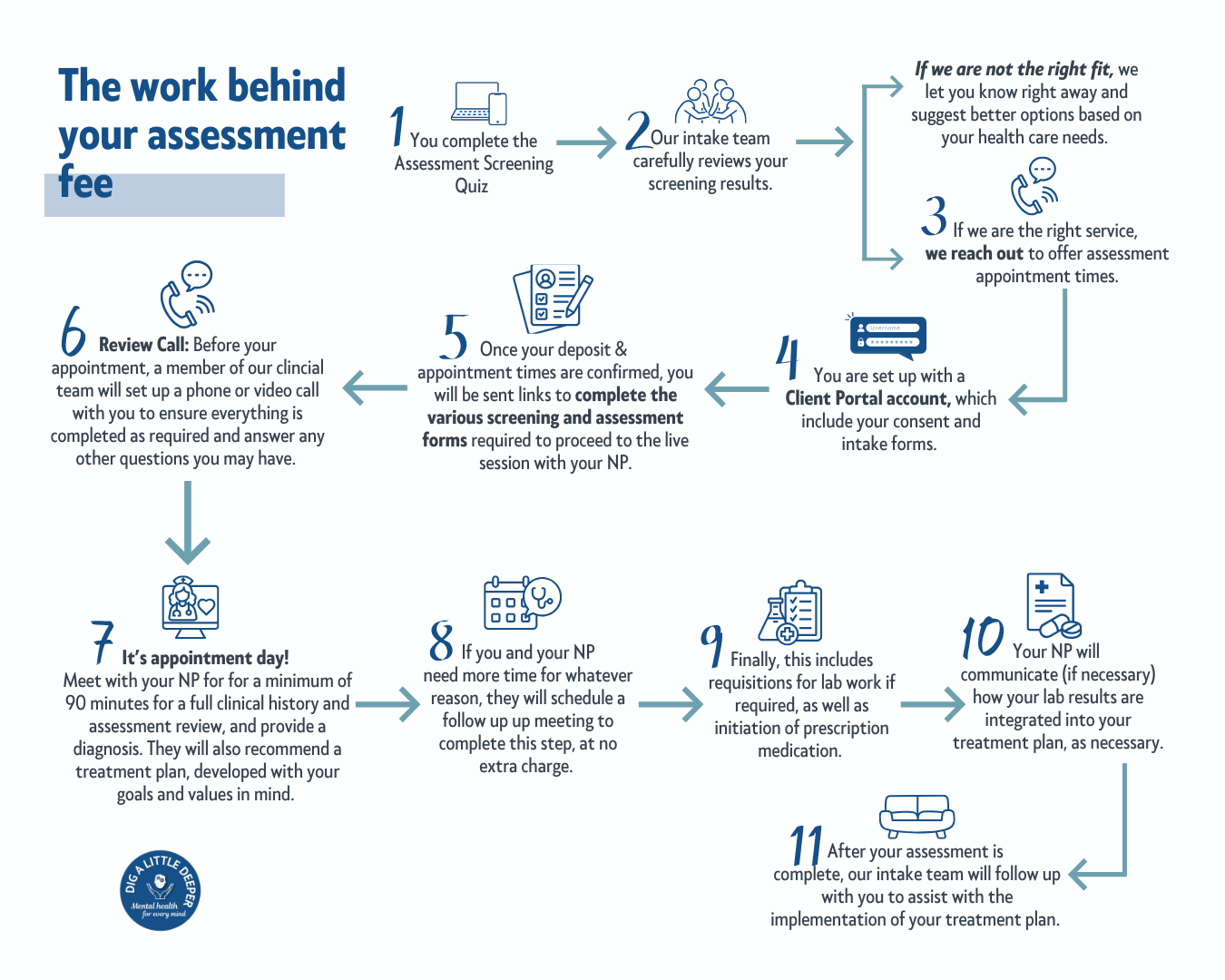
It should be thorough. At Dig a Little Deeper, we offer a full comprehensive adult or paediatric psychiatric assessment, where specialized and experienced clinicians take an in-depth look at your entire mental health profile and experiences, and make recommendations backed by science to support functioning going forward. Our team approach involves several sessions.
What to expect:
- Intake: You will be asked to complete a series of forms, that include information about your past and current symptom’s, past or current diagnoses, a family history, and if possible, we will ask you to select a loved one to also provide information about their observations of the same symptoms throughout your life. If you see a psychotherapist on our team, they will also provide an internal referral to help supplement this information. Your NP will have reviewed this information in detail before your appointment.
- Medical Assessment: In your assessment appointment, you’ll meet with a specialized mental health Nurse Practitioner. Your NP will conduct a detailed medical and developmental history, and ask about current and past functioning. If there are still reports or forms outstanding at the time of your assessment, and your NP deems them necessary to continue, you will have a follow up appointment booked at no extra cost, before a final diagnosis (if any) and/or treatment plan can be finalized. Most assessments are finalized with one assessment session.
- Results: Either at your first or follow up assessment appointment, your NP will discuss the findings from a medical perspective and if a diagnoisis and treatment plan is indicated, you will review it together then. You will have an opportunity to ask questions, collaborate, share your values and work together to create a plan that works for you. If you require or will benefit from medication, your NP will be able to prescribe and follow up with you for ongoing care. At your direction, a detailed Consultation report can be sent to your family physician or child’s pediatrician.
If you have a confirmed psychiatric diagnosis and would like to review and adjust your treatment plan only (medication), you may book a Medication Assessment. You must be able to submit a written report from the clinician who diagnosed you, confirming your diagnosis to receive this type of appointment.
Your NP will review the report prior to meeting with you. If you have more than one mental health diagnosis and the NP requires a more thorough assessment to confirm diagnosis, you may still require a psychiatric re-evaluation and need to book a full adult assessment.
Our Guide for Parents
Please click the image below to download our brief PDF Guide for Parents about what they can expect with a paediatric assessment with Dig a Little Deeper, Psychotherapy & Counselling.

A note about age of consent, privacy and confidentiality of patients, regardless of who might be paying for a private service:It is a fundamental responsibility of all Ontario regulated health care providers to maintain client confidentiality at all times. In compliance with PHIPA (Ontario’s Personal Health Information Protection Act), health care providers must ensure that the professional relationship with the client and the client’s personal information are kept confidential, within legal limitations, which includes children (or adult children for whom you might be paying for an assessment for). Parents with court ordered Parenting Plans must inform their Nurse Practitioner about court ordered responsibility for medical decision making before commencing assessment. In general, all parents are invited to be actively involved in the information gathering part of any medical assessment for minor children. Once the interview with your child is completed, the parents are asked to rejoin their child for discussion of the diagnosis and treatment planning. Various options for treatment will be discussed. Risks and benefits of each option will be reviewed. We will spend some time letting both parents and child ask questions. It is important to note, in accordance with PHIPA the consent must be signed by the patient if they are 12 years of age or older. Parental consent is accepted if the patient is less than 12 years of age, or is incapable of consenting. If there is a conflict between the child and the parent, the capable child’s decision prevails with respect to consent. |
NP services are considered a “non-insured health benefit”, like almost all mental health care, a massage therapist, physiotherapist or dentistry. Patients are required to “pay out of pocket” for non-insured health benefits, or carry additional health insurance. Many insurance companies such as SGI, WSIB, and some employee health benefit plans do cover Nurse Practitioner services.
Please contact your insurance company to inquire about your coverage. Much of the work that is required by patients in the community involves other agencies that may not recognize NP practice. This is changing! For example, Worker’s Compensation, SGI and some insurance companies now accept an NP as a primary care provider. They recognize the work from NP’s equal to the same work done by physicians. Most recently Revenue Canada has accepted NPs as providers for documents such as the Disability Tax Credit. The Coroner’s office and Department of Vital statistics also accepts NP signatures on documents. Slowly most agencies are recognizing that for many Canadians, an NP instead of a physician is the primary provider.
If your insurance company would like an assessment quote to see if you can get coverage, please let your therapist or nurse know and they can provide one for you in advance of your appointment. Please note that you should explore your coverage options before you book your appointment.
At Dig A Little Deeper, our integrated mental health clinic provides comprehensive psychiatric and mental health assessments conducted by experienced clinicians. While many people seek assessment because they suspect ADHD, our process examines the full clinical picture rather than assessing ADHD in isolation.
This approach helps ensure that symptoms are understood in context and that recommendations are grounded in careful evaluation. When appropriate, individuals can also access coordinated follow up care within our team including psychotherapy, coaching and medical consultation.
Thoughtful assessment takes time. Our goal is to provide care that is careful, responsible and focused on helping individuals and families better understand their mental health and the options available to them.


;?>/smartquizbuilder/includes/images/sqb-registration-img.jpg "FAQs for Integrated Mental Health Care 146")