

By Christina Crowe, RP and Clinical Supervisor
No time like the present, eh? If the kids are driving you nuts and you don’t want to keep locking yourself in the bathroom, I’ve got one more family activity for you to bust out on them.
Family mindfulness time is a great way to sharpen everyone’s skills in self-regulation, or emotional regulation. In fact, if your child goes to a school where a teacher has ventured to teach his/her class, they might be one step ahead of you.
Rather than lay out the evidence for why mindfulness rocks, I’ll let you try it. The proof is in the pudding, as they say. This is one of those things I don’t believe in any way can harm you, and might only potentially benefit you, especially at a time like this.
There is a brief intro to my take on mindfulness meditation, and the context within which I teach it, on our Youtube page, so I’ve added it here.
As I mention in the video, the word “meditation” actually refers to many different practices. In our world, the most well-known set of practices is “mindfulness meditation.”
This means: paying attention, purposefully and non-judgmentally, to your experience in the present moment.
It can be formal — like when you sit down, close your eyes, and focus on feeling your breath go in and out. But you can also practice mindfulness while you take a shower, wash dishes, or shop for your groceries.
The best (and easiest) way to start a mindfulness practice is to encourage your child to focus on her breathing.
HERE ARE 6 EASY, KID-FRIENDLY TECHNIQUES TO HELP GET YOU STARTED.

The Hot Chocolate Breath:
This technique starts with your child holding up an imaginary mug of hot chocolate, right under her nose. Describe the cup for her, so she gets the idea, that it’s warm, maybe she can see some steam? And then inhale that lovely aroma.
Together,
- inhale deeply through the nose,
- and then blowing it to cool it down,
- exhaling smoothly across the surface out the mouth.
- Repeat this breathing pattern and visualization — in through her nose smelling, and back out through her mouth, cooling off — for a minute or two.
- Encourage her to let her breath find its own rhythm: not too fast, and not too slow.
Using imagery like this — connecting the exercise to the pleasant sensation of drinking hot chocolate — provides kids with a positive association and helps them make sense of their breathing patterns.
Slow, deliberate breathing is what calms down the body and the brain; the visualization jumpstarts the prefrontal cortex and helps kids focus their wandering attention.The Playground Slide: This has been my recent favorite. Imagine you are at the playground, and you want to go down the slide. As you imagine yourself climbing the stairs, take a deep inhale for a count of 4. Then hold for a count of 4 at the top – while you wait for the other kids at the bottom to get out of the way. The with a whoosh – exhale quickly – as you slide down the slide. And then hold again, as you go back to the stairs, to climb up again. Repeat 4 to 5 times.
The Breath Button:
One of the mainstays of mindfulness is learning to take big, deep diaphragmic breaths and recognizing how good it feels to let them go. This can be done sitting still, or you can designate a ‘Breath Button’ in your home. You and your child pick an object anywhere in the house — a doorknob, a special toy, a piece of paper on the wall that says “breath button” — and make a rule that whenever your child touches that object, she’ll take a big, mindful breath.
I Notice:
Instead if “I Spy” (our 80’s classic), play “I Notice…” This is basically “I Spy,” but with a range of answers, which teaches your child to develop awareness outside of themselves (or their racing throughts). Chances are, once they look, they’ll find things you never noticed before either. Try to find an object in each color of the rainbow, notice different textures (soft, hard, prickly, squishy), or shapes (square, circle, triangle). You can combine this with a body scan by which you identify sensations in your body you might otherwise not think about, like how we can ‘relax’ our eyebrows.
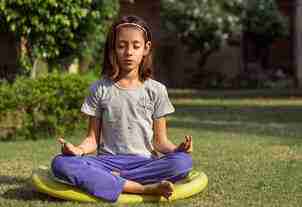
Yoga:
Balance poses, like Tree, encourage focus and control. Upside-down poses, like legs raised against the wall or a shoulder stand, encourage calm. There are a lot of great resources available for introductions.
Try Cosmic Kids yoga on YouTube for some inspiration.
Calm Kids: The kids’ section on the Calm App! The Calm app gets better each year, and I especially love the Calm Kids section, with meditations by age for your kids.
MORE RESOURCES
Online Psychotherapy & Counselling:We have always offered secure, online therapy, because being able to get into an office shouldn’t be a barrier to mental health support. If you’d like to learn more, visit our online psychotherapy info page, and you can book in right online with the therapist of your choice.
If you are an small business employer and are looking for local supports for your employees or contractors, get in touch and let us know your needs.
PARENTING ARTICLES FROM US:
- Agile Parenting: Working from home, while parenting by Christina Crowe
- Modern Fatherhood: Coming up for A.I.R. by John Foulkes
- The ABC’s to Feeling Better by John Foulkes
- Breaking Patterns in Parenting by John Foulkes
- Pandemic Parenting: Personal Un-Distancing by John Foulkes
- Parenting through transformative experiences: how an ADHD diagnosis can change your family life for the better. by Sabrina Belo
LOOKING FOR 1:1 SUPPORT?
MEET THE TEAM
If you prefer talking to a human to help find the right therapist for you,
Call 905-584-8963,
or email admin@digalittledeeper.ca
You can expect a reply within 24-48 hours, Mon-Fri, during regular business hours.

2 thoughts on “Ready to Try Mindfulness Meditation? 6 Simple Tips to Make It a Family Habit”
Thank you for sharing informative content. It means a lot to me hope you do more articles to post.
One of the mainstays of mindfulness is learning to take big, deep diaphragmic breaths and recognizing how good it feels to let them go. I’m so thankful for your helpful post!
REPLY