

By: Jill Roberts, OT
Living with ADHD means that completing everyday tasks is challenging (if not impossible at times). This can look like falling behind on basic things like paying bills, making dinner, or finishing a work project. These challenges come from the way ADHD affects executive functioning, memory, and focus – which makes starting and completing tasks difficult.
Occupational therapy (OT) helps by breaking these daily activities down into manageable steps, adjusting your environment, and creating strategies that work with your ADHD brain.
OTs can also meet with you at home, offering support right where the challenges show up.

The result?
More completed tasks, less overwhelm, and more energy to put into your goals, your relationships, and the activities that bring you joy.
What “occupation” really means
In occupational therapy, the word “occupation” doesn’t just mean your job. It’s any activity that matters in your life:
- Things you need to do, like taking care of yourself and others, and meeting work or school deadlines,
- Things you want to do, such as hobbies, or spending time with friends,
- Things you’re expected to do, including keeping up with commitments.
When ADHD makes these tasks more difficult to complete, occupational therapy offers tools and support to make life manageable.
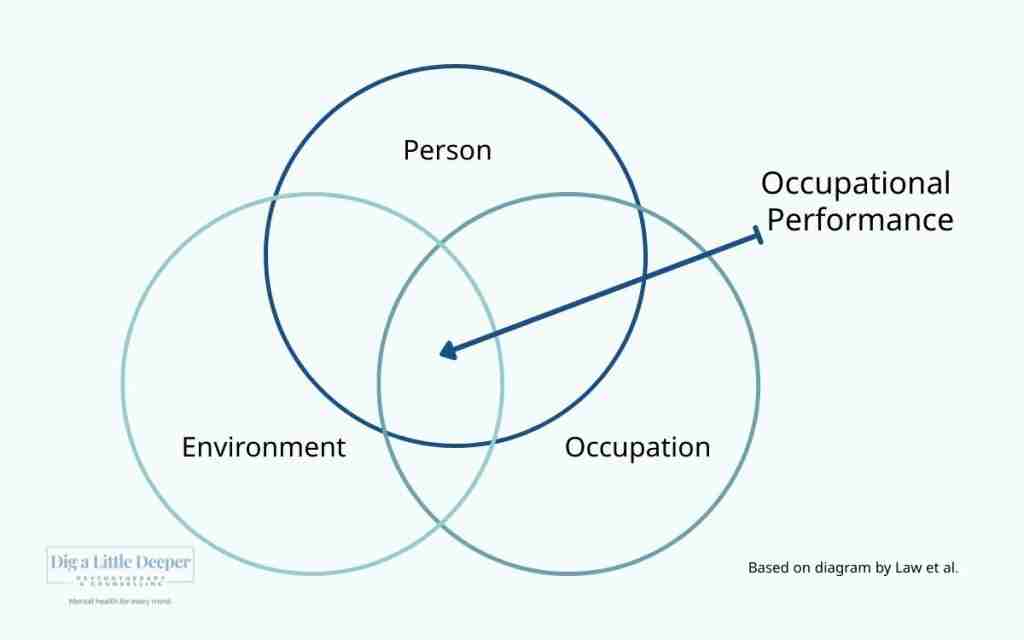
A key framework OTs use is called the PEO model, which looks at the interaction between:
- Person – your unique skills, challenges, values, and goals. For example, your executive functioning skills, motivation, or emotional regulation.
- Environment – the physical, social, and sensory spaces around you, like your home, workplace, or support systems. The setup of your environment can either help or make things harder.
- Occupation – the actual activities or tasks you’re trying to complete, whether that’s cooking a meal, managing emails, or sticking to a reasonable nighttime routine.

In OT, we explore how these three pieces fit together. If there’s a mismatch, say your environment isn’t set up for success, or the task is too complex, that’s where challenges show up.
Breaking things down
One tool OTs use is task analysis. This means breaking down a task into smaller, step-by-step parts to figure out exactly where the barriers are.
For example, if someone struggles to make dinner, the barrier might not be cooking itself, but planning the meal, remembering ingredients, or getting started. By analyzing the task, we can create strategies or supports that make it more manageable.
The PEO model and task analysis allow OTs to take a big-picture view, while also getting practical about day-to-day challenges.
What this can look like in real life
Using this framework, I’ve helped clients:
- Arrange their spaces (like kitchens, home offices, entryways, or closets) so that daily tasks run more smoothly,
- Create and maintain self-care routines that are functional,
- Reduce sensory overwhelm at home, school, or work,
- Set up organizational systems to keep track of work, school, or household activities,
- Build flexible habits that work even when life changes,
- Carve out more time and energy for hobbies and meaningful activities.

Overall, these approaches help people feel more capable, confident, and able to live in a way that matches their values and goals.
Ready to learn more?
If this resonates with you, I’d love to connect!
You can book a free 15-minute virtual consultation to ask questions about OT, Psychotherapy, Coaching, or ADHD support — or how we might be a good fit.
